
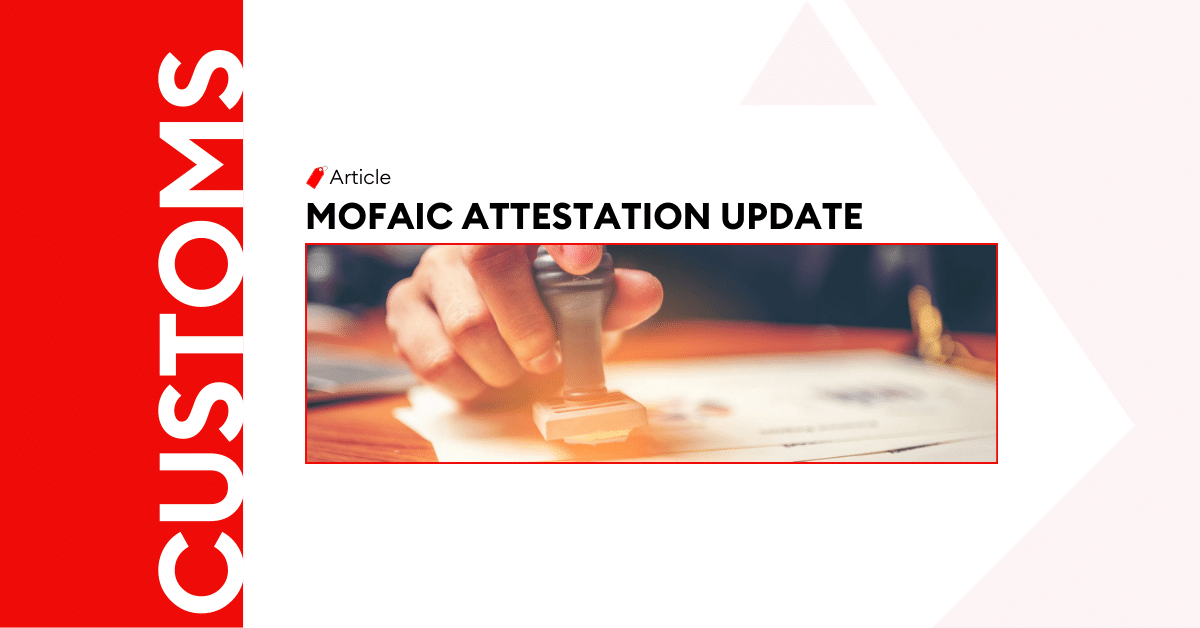
MOFAIC Attestation Update – Dubai Customs GuideÂ
For UAE importers and exporters, MOFA attestation in Dubai is more than paperwork—it’s a clearance-and-compliance gate. When a shipment, contract, or authorization hinges on a foreign-issued document, getting the legalization sequence wrong can translate into Dubai Customs delays, avoidable storage and demurrage costs, rejected declarations, and disruptions to supplier and customer timelines.Â
Â
This guide is written specifically for UAE traders and logistics teams handling commercial documents for customs clearance and cross-border transactions. It covers the MOFAIC attestation process, where shipments typically get held up, how to avoid MOFAIC rejection for trade paperwork, and how Al Sharqi Shipping can coordinate attestation so your documents are accepted without delays.Â
What Is MOFA Attestation and Who Needs It?
MOFAIC document attestation is the government’s verification that makes foreign-issued commercial and legal documents acceptable to UAE authorities and counterparties. It is commonly needed when a shipment, contract, authorization, or company paper must be recognized for Dubai Customs clearance and compliant trade execution.
For freight forwarding companies in Dubai and their clients, attestation is not an isolated administrative task, it sits directly within the customs clearance workflow, and delays at this stage ripple across the entire shipment timeline.
Importance of MOFAIC Attestation in the UAE
MOFAIC UAE attestation ensures that trade-critical paperwork is accepted for clearance, audits, and commercial execution. It reduces the risk of Dubai Customs holds, rejected declarations, and disputes with buyers, suppliers, or banks when documents, such as authorizations, agreements, or company papers, must be formally recognized in the UAE.Â
For shipping and logistics companies in Dubai managing multi-party supply chains, having correctly attested documents in place before cargo arrives is one of the most effective ways to avoid costly ancillary charges triggered by clearance delays, port storage, or demurrage.
Who Benefits the Most from MOFA Attestation?
- Importers & Exporters: Traders who must present legalized commercial documents to support clearance, contractual obligations, or regulatory checks, including those managing cross-border logistics between the UAE and GCC markets.
- Logistics, Customs Clearance & Documentation Teams: Staff responsible for preparing declarations and avoiding holds caused by missing or incorrectly legalized paperwork. Teams handling export customs declaration filing in particular must ensure that all supporting authority documents are attested before submission cut-offs.
- Procurement, Sales & Finance (Trade): Teams who rely on recognized contracts and authorizations for payment terms, credit, and dispute protectionÂ
Situations Where MOFA Attestation Is Required
- Customs clearance support: When Dubai Customs or other authorities require legalized supporting documents for certain declarations, controlled goods, or post-clearance verification. This is especially relevant for businesses managing customs compliance services across multiple shipment types and trade lanes.
 - Agency/authorization arrangements: When appointing a representative—agent, distributor, broker—via a power of attorney or authorization letter used in the UAE.Â
 - Commercial contracts & company documents: When agreements, board resolutions, certificates, or corporate papers must be recognized for tenders, onboarding, or enforcement in the UAE.Â
 - Banking and trade finance: When banks or counterparties request legalized documents to open facilities, confirm signatory authority, or process certain payments.
4 Key Documents Needed for MOFA Attestation
- MOFAIC attestation requirements most often apply to commercial and corporate documents used to support cross-border transactions, authorize parties, and satisfy government or counterparty requirements. The exact document set depends on your shipment, Incoterms, regulated product category, and how Dubai Customs or your customer/bank requests supporting paperwork.Â
 - Corporate & authority documents: Certificates, board resolutions, signatory powers, and agency/distributor authorizations used to prove who can sign and act on behalf of a company in the UAE.Â
 - Contractual documents: Commercial agreements and supporting schedules that must be recognized for enforcement, onboarding, or dispute resolution.Â
 - Trade-support documents (case-dependent): When authorities or counterparties require legalization of specific supporting papers linked to a shipment or transaction.Â
Common Trade Documents That May Need Attestation
Depending on your situation, common documents include: Â
- Power of attorney/authorization letters for clearanceÂ
- Board resolutions and signatory powersÂ
- Agency/distributor agreementsÂ
- Certificates of incorporation/good standing, and other corporate documents requested for onboarding with customers, free zones, banks, or government entities.Â
Get In Touch
Which Declaration Types Apply to MOFAIC UAE Attestation?
In day-to-day import/export operations, MOFAIC attestation and certification relevance is typically tied to commercial and legal supporting documents behind your customs entry, authorization, or transaction file. Â
Â
The goal is to ensure Dubai Customs and other UAE entities accept your supporting paperwork when it is reviewed during clearance, inspections, audits, or post-clearance queries.Â
Â
- Commercial Declaration: Contracts, invoices/supporting papers, and corporate documents used to evidence the transaction and authority to act. It is needed when registering, contracting, or supporting clearance files with business-related documents. For businesses using customs declaration filing solution platforms, having attested documents pre-loaded into the system before submission significantly reduces rejection risk.
 - Legal/authority Declaration: Power of attorney, board resolutions, and signatory documents that authorize brokers/agents or confirm who can sign and submit. It is required when authorizing brokers, agents, or representatives to act on your company’s behalf in the UAE.Â
When Is MOFA Attestation in Dubai Not Required?
- Not all situations require Mofaic attestation in the UAE. So, let’s look at the few cases of exemptions. Â
 - UAE-issued corporate or clearance documents: If the document is already issued or validated by UAE authorities, additional MOFAIC attestation is usually not needed.Â
 - Documents not requested for your clearance file: If Dubai Customs, your free zone authority, customer, or bank does not require legalization for a specific paper in your transaction, attestation may be unnecessary.Â
 - Cases covered by alternative legalization: Where an accepted legalization route applies (for example apostille or embassy legalization), MOFAIC may only be the final step—or not required for that document type—depending on the authority’s rules.Â
3 Typical Reasons MOFA Documents Attestation Get Rejected and How to Avoid Them
For traders, an attestation rejection is not just an admin issue—it can stall a shipment, trigger storage and demurrage costs, delay payment milestones, and create knock-on delays across your supply chain. Â
The following are the most common trade-document pitfalls that cause MOFAIC attestation rejections, along with the tips to help you prevent them.
Missing Steps in Attestation
One of the most common reasons MOFAIC rejects a document is that earlier required steps were not completed. MOFAIC only accepts documents that have been properly verified in the issuing country and attested by the UAE embassy (or apostilled if applicable) before submission.Â
Â
How to avoid it: Validate the legalization route for your specific trade document. Align this with your broker’s clearance timeline so documents are ready before cargo arrival or document cut-offs. Freight forwarding companies in UAE with dedicated documentation desks can help map the correct sequence based on the country of origin and document type, reducing the risk of costly missed steps.
Incorrect Translation
Documents not in Arabic or English often need certified translations. If the translation is inaccurate, poor quality, or done by an uncertified provider, MOFAIC may reject the attestation.Â
Â
How to avoid it: Use a UAE-accepted legal translator and keep names, company details, and authorities wording consistent with your trade license and shipping documents.Â
Incomplete Documentation
Missing pages, omitted stamps, unclear scans, and absent required supporting papers often lead to rejection. Even small missing details can derail the process.Â
Â
How to avoid it: Build a trade documentation checklist and have your clearing agent review it before submission. Small gaps can result in a rejected file and time-critical shipment delays.Â
Step-by-Step MOFA Attestation Process
For import/export businesses, the key is timing. It’s best to complete the MOFAIC attestation procedure early enough to support customs filing, broker authorization, and any bank or customer onboarding.Â
The steps below explain the typical legalization sequence for foreign-issued commercial and corporate documents, so they are accepted for use in the UAE.Â
Step 1: Prepare Your Documents in the Country of Origin
Start with the basics: make sure your document is original and complete.
- Notarization:Â For most foreign documents, the first step is to have the document notarized by a local notary in the issuing country.Â
 - Attestation by Home Ministry: After notarization, the document must be attested by the country’s Ministry of Foreign Affairs or relevant authority. This confirms authenticity before moving forward.
Confirm whether your document is a corporate or authority paper, board resolution, POA, certificate, and complete origin-country notarization/authentication exactly as required. Any mismatch in company name, signatory, or stamp chain can later cause UAE rejection and delay clearance.Â
Step 2: UAE Embassy Attestation (if needed)
Once your document has been authenticated locally, it needs to pass through the UAE embassy attestation. Â
Â
If your trade document requires UAE embassy/consulate legalization, treat it as a critical-path activity. Plan this step around cargo ETD/ETA and document cut-offs so your broker has usable paperwork when filing. For businesses with shipments moving on tighter schedules, such as cross-border delivery GCC cargo with fixed border crossing windows, embassy attestation timelines should be built into the broader shipment plan, not treated as a parallel task.
Step 3: Legal Translation Requirements
- When translation is required: If your document is not in English or Arabic, a certified translation is typically required before MOFAIC can attest it.
- Certified translator options:Â Use translators recognized or approved by relevant authorities to avoid errors that could delay attestation.
Where translation is needed, ensure the translated version matches your trade license, invoices, and shipping documents, entity names, addresses, reference numbers. Consistency reduces the chance of queries during clearance or corporate onboarding.
Tariff classification services providers and customs consultants often flag translation inconsistency as one of the most preventable causes of declaration queries and post-clearance audits.
Step 4: Submit to MOFAIC and Complete the Final Attestation
This is the final official stamp that makes your document legally valid in the UAE. It’s time to visit the MOFAIC portal with your UAE Pass to upload scanned documents, pay the attestation fees, and schedule delivery or collection.
- Booking appointment: You may need to book a slot through the MOFAIC portal. Check the attestation office portal and confirm current scheduling requirements.Â
 - Online submission steps: Upload your scanned documents, pay the fees, and schedule delivery or collection. Once reviewed, MOFAIC will stamp the original document and return it to you.Â
How Al Sharqi Shipping Can Help?
Al Sharqi Shipping supports UAE importers and exporters by coordinating end-to-end services —so your POAs, corporate papers, and commercial documents are ready for customs clearance, broker onboarding, and time-sensitive shipments. We help you avoid rejection risks that lead to cargo holds and cost escalation.Â
Benefits for Customers
- Expert Guidance: With more than 30 years of experience, we help you avoid common mistakes and ensure your documents are processed smoothly.Â
- Time-Saving:Â We handle the paperwork, allowing you to focus on your business.Â
- Reduced Clearance Risk: Fewer declaration rejections, fewer document queries, and better control of landed costs by minimizing storage, demurrage, and delays linked to missing legalization.Â
Conclusion
For UAE importers and exporters, MOFA attestation is a practical compliance step that protects shipment timelines and trade execution in Dubai. When your commercial and authority documents are legalized correctly and early, you reduce Dubai Customs delays, avoid unnecessary costs, and keep supply chain commitments on track.Â
Frequently Asked Questions (FAQs)
For trade documents, the typical MOFAIC attestation procedure sequence is: origin-country notarization/authentication → UAE embassy/consulate legalization where applicable → certified translation if needed → MOFAIC final attestation. Align these steps with cargo ETD/ETA and your broker’s document cut-offs to prevent clearance delays.Â
Understanding what MOFAIC attestation is key for UAE traders: it is the government verification that makes foreign-issued commercial and corporate paperwork legally usable in the UAE, supporting customs clearance files, broker authorizations, bank requirements, and enforceable commercial agreements.Â
When selecting a provider for MOFAIC attestation services, prioritize teams that understand customs and logistics timelines, can validate the correct legalization route by country, and can coordinate fast document handling to meet shipment and clearance deadlines. Â
MOFAIC attestation time depends on the issuing country steps and embassy legalization. For traders, the best practice is to start early enough that attested originals are in hand before cargo arrival and before any broker authorization or post-clearance audit deadlines
If you’re looking for MOFA (Ministry of Foreign Affairs) attestation in Dubai, you basically have two options:Â
- Visit an official MOFAIC center (government) Â
- Use private attestation service providers (they handle everything for you)Â
Yes, MOFAIC’s final step can be completed online for many cases. However, traders must still account for upstream legalization and the need for original stamped documents for broker onboarding or compliance files.Â
To get MOFAIC attestation for import/export paperwork: confirm the document type (POA, corporate authority, agreement), complete origin-country authentication, obtain UAE embassy legalization if required, and then complete MOFAIC final attestation. Share finalized documents with your clearing agent before filing to avoid last-minute holds.Â
MOFAICÂ attestation requirements vary by document and country, but commonly include origin-country authentication, UAE embassy legalization where applicable, and MOFAIC final attestation, especially for POAs and corporate authority documents used by brokers/agents in the UAE.Â
MOFAIC attestation fees vary based on document type and service provider. Budget not only the MOFAIC fee but also upstream embassy/legalization costs, couriering of originals, and translation where required. For traders, the real cost driver is often delay risk, so prioritize accuracy and turnaround to avoid storage, demurrage, and missed delivery commitments.Â
Our customer service team is happy to assist you with planing your next booking.
Related Articles
Reliable Temperature-Sensitive Pharmaceutical Delivery from UAE to South Africa | Case Study
Summary Al Sharqi provided a seamless logistics solution for the transportation of temperature-sensi
Handling Used Car Imports and Re-Exports from UAE to Kenya | A Case Study
Tagline:Expert Customs Handling and Secure Ocean Freight Summary Our client required a seamless and
Specialized Solutions for Exporting Industrial Waste from UAE | A Case Study
Tagline: Ensuring Compliance and Efficiency in Chemical Logistics Summary Managing the export of Bul