


Home » Air Freight Pricing 2026- What they Do Not Tell You

Air Freight Pricing 2026- What they Do Not Tell You

Air Freight Pricing 2026- What they Do Not Tell You

Air freight pricing in the UAE is calculated on chargeable weight, the higher of a shipment’s actual weight or its dimensional (volumetric) weight, multiplied by a base rate, then adjusted with surcharges for fuel, security, and handling. That single formula explains most of the air freight pricing challenges businesses run into with their invoices: two shipments of the same actual weight can be billed very differently depending on how much space they take up on the aircraft.

Because the cost of air freight shipping touches almost every import-export business at some point, this guide breaks down exactly how international air freight pricing works, what drives it up or down, and what UAE businesses can do to keep costs predictable.

What Is Air Freight Pricing?

Air freight pricing, or air cargo pricing, refers to the method airlines and freight forwarders use to price the transport of goods by air. In the UAE, pricing is shaped by a mix of global airline capacity, regional route density, fuel markets, and airport-specific handling costs, which is why the same shipment can quote differently depending on which carrier, forwarder, and week you book with.

At its core, every quote for air freight services is built from three layers:

  1. Base rate — priced against chargeable weight
  2. Surcharges — fuel, security, and other variable add-ons
  3. Handling and service fees — airport, documentation, and origin/destination charges

What are the Major Forms of Air Freight?

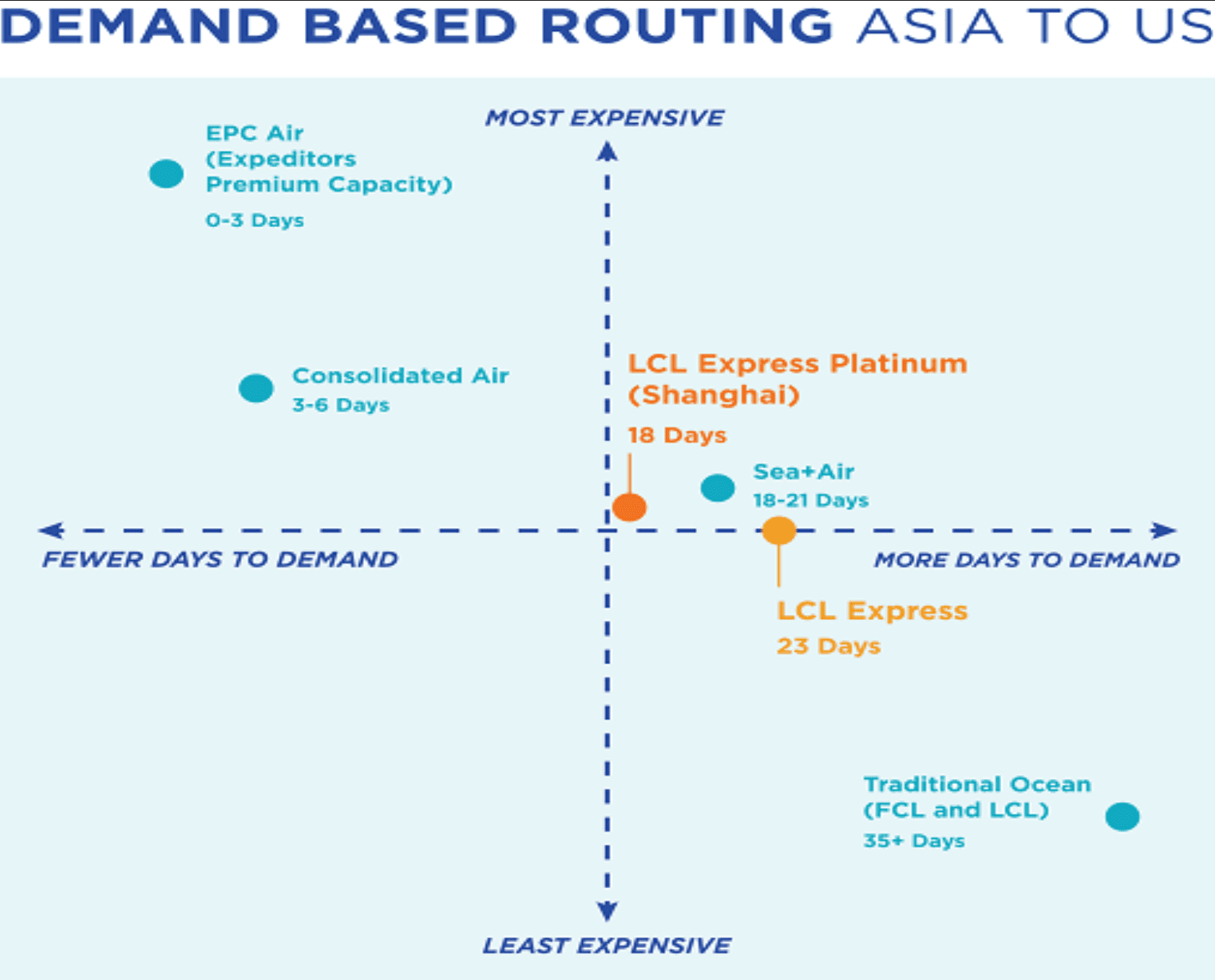
When dealing with air freight, logistics companies offer variety of services to individuals and businesses. These typically come in three (3) service levels; Standard, Premium, and Express shipping. 

As you would expect, these products mainly differ by costs and speed of delivery. Let’s briefly go over each one. 

demand based routing asia to us

1. General Economy / Standard Air Freight

Firstly, there’s the Standard freight option. It is the most cost-effective mode of moving goods by air of all the air freight products. 

Standard air freight is ideal for shippers seeking a less expensive yet fast and reliable cargo transport. This normally involves shipments that must be delivered quickly but not within a critical time period. 

These refer to general goods and lower deck air freight cargo for all possible commodities and dimensions transported in air freight. 

Goods are carried by regular passenger or special freight airlines and move within 4 to 7 days from one airport to another. Multiple shipments are usually consolidated together in back-to-back, branch-to-branch to branch consolidation. 

Uplift occurs within five days of any possible/available flight. Though you cannot track the progress of your goods, carriers offer dedicated customer service for inquiries. Port of discharge (POD) usually occurs 24 hours after passing customs clearance. 

2. Air Freight Now / Premium

Next up, we have the flexible Premium air freight service with air cargo rates UAE for expedited shipping. Premium offers a competitive rate to Express shipping, but within a more predictable/expected delivery time than Standard air freight. 

Goods transported involve a variety of cargo with specific, commodity-bound handling requirements. The Premium service is ideal for delivering your goods just in time within a short time frame. 

Air freight usually moves from airport to airport within 2 to 4 days. The Premium service option allows you to select a choice carrier and routing service. 

In terms of consolidation, you get back-to-back, direct, or consolidated services, and flight takes place within three days of the subsequent available/possible uplift. 

Goods are handled as a priority, and while in transit, trace and trace visibility is available in real-time. And, within 8 hours of custom clearance, you get POD confirmation. 

3. Air Freight Express / Super Fast

Express air freight is the fastest of the 3 freight services. It’s perfect for goods that need to be carried in the most time-sensitive and ultra-urgent fashion. Naturally, these goods must be shipped with the next flight out to their destinations. For mostly high-value shipments, they’ll need a personal touch throughout from packaging to final delivery. 

Essentially, an Express air freight service offers the highest speed available with an equally high-reliability rate in transporting your goods with express air cargo rates UAE. Transit time from one airport to the other happens between 24 to 48 hours. Goods are carried by passenger airlines, ensuring direct or no consolidation. 

Uplift of goods generally happens with the next possible flight out (within 24 hours), with the advantage of fast processing and priority handling at departure and arrival. Also, you can trace the movement of your goods with an express service. POD confirmation occurs less than 2 hours of customs clearance. Typical cargo types are general cargo, either main or lower deck cargo, and onboard courier. 

Service Levels: General, Priority, and Express (Quick Summary)

Air carriers typically offer tiered service levels, each priced against the General Cargo Rate with a different premium:

Service levelSpeedTypical use casePrice relative to GCR
General / StandardSlower, scheduledRoutine, non-urgent cargoBase rate (GCR)
PriorityFaster than generalTime-sensitive but not critical shipmentsPremium over GCR
ExpressFastest availableUrgent, high-value, or deadline-critical cargoHighest premium over GCR


This is the same structure Al Sharqi Shipping offers through its General Economy / Standard, Air Freight Now / Premium, and Air Freight Express / Super-Fast tiers, each mapped to a different point on the speed-versus-cost trade-off.

9 Common Air Freight Terms You Should Know to Negotiate Better with Freight Forwarders

In arranging air freight, you can outsource the operations to a 3PL that handles everything from packing and shipping to warehousing and order fulfillment. You may not need all the services of a 3PL. As a result, you can hire a freight forwarder to handle the shipping and delivery process. 

A freight forwarder is usually responsible for booking your air freight, handling customs and insurance issues, providing advice generally on air freight, as well as performing a whole lot of other duties. They operate like travel agents, but for cargo rather than passengers. So, they often offer the best deals to transport your air freight. 

However, it is crucial to understand vital freight terms to ensure you’re getting the right deal for you when dealing with freight forwarders. Let’s look at some of them below. 

1. Direct Air Waybill (DAWB)

A freight forwarder issues a master airway bill (MAWB), a document which contains information about a shipment, to a carrier. When the MAWB lists the actual exporter/importer, not the airfreight agent, as the shipper of a good, this is a Direct Air Waybill (DAWB). 


It’s also rendered for direct shipments of express goods and where the freight is not consolidated with other air cargo. You do not have to wait for cargo transfer with this service as it is not moved to any off-site forwarder warehouse. 

2. One House Air Way Bill (1HAWB)

One House Air Way Bill (HAWB) shows the carrying agent as the shipper. 


The 1HAWB signifies that the freight forwarder is obligated to deliver your goods to any previously agreed destination. 

3. Master Air Way Bill (MAWB)

MAWB is a bill issued by the carrier of a good to a freight forwarder after the forwarding agent has received the shipment. The forwarder then moves the shipment to a previously named location stated in the shipping agreement. 

4. House Air Waybill (HAWB)

Contrary to the MAWB, the House Air Waybill (HAWB) is issued by a forwarding agent to a carrier/shipper after receiving a shipment. 


It shows the conditions specified for transporting the goods, as well as a confirmed agreement to deliver to a selected destination. 

5. Direct Shipping

Direct air freight refers to the shipment delivery directly to a customer, excluding the cargoes belonging to other importers. Shipment is classified as single under one MAWB.  

6. Back-to-Back Shipment

Similar to direct shipment, this service is used when customers want to ship multiple goods under a single MAWB. However, its costly as a customer is required to fill an entire scheduled plane hold.  

7. Co load Shipment

Coloading occurs when a freight forwarder transfers goods to another freight forwarder or a consolidator. Its common with less than truckload (LTL) for saving costs on transportation, inventory, and damage to goods. 

8. Consolidated Air Freight Shipment

Also called consol, this shipment involves goods from multiple customers transported together by air, with each consignment having its HAWB.  


Contrary to back-to-back shipment, you get cheaper shipping rates as you’re utilizing a portion, rather than all, of the cargo space.  

9. General Cargo Rate (GCR)

A General Cargo Rate (GCR) is the standard, published base rate airlines apply to ordinary, non-specialized cargo on a given route, the default pricing tier before any surcharges or special handling fees are added. It sits underneath the service-level tiers (general, priority, express) as the baseline rate the tier premium is calculated against.

Understanding the GCR matters because it’s the number most comparable across quotes: two forwarders quoting different “all-in” prices may be applying the same GCR but bundling different surcharges or service fees on top of it. Asking specifically for the GCR breakdown is one of the simplest ways to compare quotes on a like-for-like basis.

(Note: exact current GCR figures are carrier- and route-specific and change frequently, treat any specific rate quoted here as indicative only and confirm current pricing directly with your forwarder.)

How Air Freight Pricing Is Calculated?

Understanding how is air freight pricing calculated starts with one core concept: chargeable weight.

Chargeable Weight: Volume vs. Weight in Air Freight

Airlines don’t simply charge by the kilogram on the scale. They compare actual weight against dimensional (volumetric) weight and bill whichever is higher. This is the essence of volume vs. weight in air freight pricing, it exists because a large, lightweight shipment takes up aircraft space that a dense, heavy shipment of the same weight would not.

The standard formula used to calculate air freight charges is:

Dimensional weight (kg) = (Length × Width × Height in cm) ÷ 6000

Industry-standard calculators consistently use this 6000 divisor for air freight, which is equivalent to treating 1 cubic metre of volume as roughly 167 kg of chargeable weight.

Worked example: A pallet measuring 140 cm × 100 cm × 90 cm has a volume of 1.26 CBM. At the air freight conversion, that works out to a dimensional weight of roughly 210 kg. If the pallet’s actual scale weight is only 150 kg, the airline will bill the shipment at 210 kg, the higher of the two figures, not the lower actual weight.

This is why packaging efficiency has a direct, measurable effect on cost: reducing unnecessary volume lowers dimensional weight even when actual weight stays the same.

Air Freight Surcharge Explained: What Gets Added on Top of the Base Rate

An air freight surcharge, explained simply, is any additional charge layered on top of the GCR to cover a specific cost the airline or forwarder incurs. Together, these surcharges make up a large part of the total air freight cost breakdown on any invoice:

  • Fuel surcharge (FSC) — tied to global jet fuel prices and reflects the direct impact of fuel costs on air freight; it moves up and down with the oil market and is reset regularly by carriers.
  • Security surcharge — mandatory screening and security handling fees applied to most air cargo.
  • War risk / route-specific surcharges — applied on certain lanes affected by geopolitical disruption or rerouting.
  • Handling, terminal, and ancillary charges — general cargo handling fees, including any drop-off charges at origin, charged at both airports for processing the shipment.
  • Dangerous goods (DG) surcharge — applies to regulated or hazardous cargo, priced as a percentage over the base rate depending on hazard classification.
  • Temperature-controlled surcharge — applies to pharmaceuticals, perishables, and other cargo requiring climate-controlled handling, reflecting the additional equipment involved.

Who ends up responsible for which surcharge often comes down to the shipping terms agreed at booking, under CPT Incoterms or a door to door Incoterms arrangement, for example, the seller typically absorbs more of the freight and ancillary charges upfront, while other terms leave more of these costs to the buyer. It’s worth confirming this with your forwarder before assuming a quote is “final.”

Manual verification note: Fuel surcharge percentages and specific dollar figures vary significantly by route, carrier, and time period, and reputable sources disagree on exact current ranges. Do not treat any specific percentage as fixed, confirm current surcharge levels with your carrier or forwarder before quoting a customer.

6 Key Drivers of Air Freight Prices in the UAE

These are the key drivers of air freight prices and the broader factors affecting air freight rates that UAE businesses should watch:

  • Fuel costs and surcharges: Fuel remains one of the largest and most volatile cost components in air logistics, moving with global oil prices and triggering frequent surcharge adjustments a major reason behind fluctuating air freight rates week to week.
  • Route density and competition: Routes with high flight frequency and multiple competing carriers such as those served by major UAE-based carriers including Etihad Cargo in Abu Dhabi, tend to price more competitively than thin, less-serviced lanes, where limited capacity can push rates well above average.
  • Seasonality and peak demand: During peak periods, major trade cycles, holiday seasons, demand for cargo space rises sharply relative to available capacity, pushing prices up.
  • Cargo type and classification: Dangerous goods, temperature-controlled cargo, and oversized freight each carry their own surcharge logic on top of the base rate, separate from standard general cargo.
  • Capacity and space availability: Aircraft cargo space is finite. When capacity tightens, due to demand spikes or reduced flight schedules, remaining space is priced at a premium.
  • Airport fees and handling charges: Airports apply handling, security, and operational charges at both origin and destination, and these vary by airport and are added on top of the airline’s base rate.

Air Freight Cost Comparison: Air vs. Sea Freight

Part of any sound air freight pricing strategy is knowing when air freight is worth the premium over sea. Here’s a straightforward air freight cost comparison against ocean freight services:

ParameterAir FreightSea Freight
Cost per unitHigher per kgLower per container
SpeedVery fastSlower transit
Best suited forHigh-value, urgent, or time-sensitive goodsBulk, low-urgency cargo
Sensitivity to volumeHigh (dimensional weight matters a lot)Lower relative impact on total cost


Air freight is generally chosen when speed and reliability outweigh cost, for urgent orders, high-value goods, or replenishment during inventory shortages. For bulk, less time-sensitive cargo, sea freight services in Dubai typically remain the more cost-effective route.

Understanding Air Freight Quotes: How to Estimate Your Cost Before You Book?

Understanding air freight quotes before you book helps you compare offers on equal footing and avoid surprise line items:

  1. Calculate chargeable weight. Measure your shipment’s dimensions and actual weight, then compare against the dimensional weight formula above to see which applies.
  2. Request the GCR and surcharge breakdown. Ask your forwarder to itemize the base rate separately from fuel, security, and handling surcharges, this makes quotes genuinely comparable.
  3. Compare service levels against your actual deadline. If your shipment isn’t time-critical, a general or standard service tier can meaningfully reduce cost compared to express.

5 Practical Air Freight Pricing Strategies to Reduce Costs

These air freight pricing strategies can help reduce air freight expenses without compromising reliability:

  • Consolidate shipments: Combining multiple smaller shipments into a single consignment improves space utilization and reduces the per-unit cost, one of the more accessible cheap air freight options available to smaller shippers.

  • Use near-airport distribution hubs: Positioning inventory at a regional distribution center or distribution center in the UAE close to the airport reduces ground transportation time and cost ahead of the air leg, and simplifies coordination with land transport companies in UAE handling the final airport transfer.

  • Negotiate with carriers and forwarders: Negotiating air freight rates through long-term partnerships and volume commitments can support better pricing agreements over time, worth revisiting periodically as your shipping volume changes.

  • Choose flexible service levels: Where your timeline allows, standard or deferred service instead of express can significantly reduce cost per shipment.

  • Improve packaging efficiency: Since dimensional weight is based on volume, tighter, more efficient packaging directly lowers chargeable weight,  and therefore cost, even when actual weight is unchanged.

Industries That Rely Most on Air Freight

These sectors typically prioritize delivery speed and product condition over the lower per-unit cost of sea freight.

How Al Sharqi Shipping Helps You Manage Air Freight Pricing?

As one of the top freight forwarding companies in Dubai, Al Sharqi Shipping Co LLC helps businesses control air freight pricing through route optimization, carrier selection support, and transparent rate breakdowns, so you know exactly what you’re paying for before you commit to a shipment.

Services include:

  • Route optimization to reduce transit costs
  • Carrier selection and negotiation support
  • Real-time freight tracking and visibility
  • Supply chain planning for cost efficiency
  • Last-mile delivery in Dubai and across the UAE to complete the journey after your cargo clears the airport

Al Sharqi offers three flexible air freight & logistics service tiers to match different budget and urgency needs:

  • General Economy / Standard Air Freight
  • Air Freight Now / Premium
  • Air Freight Express / Super-Fast

With air cargo operations covering both Dubai and Abu Dhabi, Al Sharqi Shipping works with businesses across the Emirates to plan air freight around actual budget and deadline needs rather than a one-size-fits-all rate.

Key Takeaway

Knowing the available service levels for arranging air freight is a necessary bit of information. However, it’s also equally vital to engage in productive negotiations and air cargo rates UAE when dealing with freight forwarders or forwarding agents. 

An essential tip is to become familiar with the common terminology of the air freight business. With this knowledge, you’ll quickly realize that understanding air freight is less of a myth than it is claimed to be. 

Need a clear breakdown of what your next air shipment will actually cost? Request a quote or message our team on WhatsApp for a rate comparison based on your specific cargo, route, and timeline.

Frequently Asked Questions (FAQs)

Air freight cost is calculated using chargeable weight (the higher of actual or dimensional weight), multiplied by the applicable base rate (GCR), plus fuel, security, and handling surcharges.

Per-kg pricing depends on route, carrier, season, and current fuel surcharge levels, so it varies shipment to shipment. (Manual verification required: confirm current rate ranges with Al Sharqi Shipping before publishing any specific figure.)

For air freight, 1 CBM is treated as roughly 167 kg of chargeable weight, based on the standard dimensional weight divisor of 6000.

Key factors include fuel costs, cargo weight and volume, route density and competition, seasonal demand, aircraft capacity, and airport handling charges.

Compare based on the GCR, itemized surcharges, included services, and transit time, not just the final all-in figure, since bundled services can vary between forwarders.

Air freight suits urgent, high-value, or time-sensitive shipments. Sea freight is generally more cost-effective for bulk, lower-urgency cargo.

Our customer service team is happy to assist you with planing your next booking.

mascot

Tags: Air

Related Articles

Post a comment