

Home » Supply Chain and Logistics Update – October 2026

Supply Chain and Logistics Update – October 2026
al sharqi freight forwarding and supply chainn market update october 2026

Supply Chain and Logistics Update – October 2026
UAE Pushes for Deeper Gulf Industrial Integration

Gulf Cooperation Council representatives attending a regional trade and industrial cooperation meeting in Bahrain in October 2026.

The UAE is seeking closer industrial co-operation with GCC countries to strengthen regional supply chains, support economic diversification, and reduce reliance on overseas suppliers. A UAE delegation led by Dr Sultan Al Jaber, Minister of Industry and Advanced Technology, is taking part in GCC ministerial meetings in Bahrain focused on industrial co-operation and standardization. For the shipping and logistics companies in Dubai that move these industrial flows, deeper Gulf integration means more cross-GCC cargo, more ocean freight and air freight demand, and a growing need for reliable customs and warehousing partners.

The discussions are centred on creating more resilient and competitive Gulf supply chains, accelerating the use of advanced technologies and artificial intelligence, and encouraging stronger private-sector partnerships across manufacturing and investment. 

GCC Co-operation and Industrial Transformation

The meetings are being held alongside the inaugural Made in GCC Forum and Exhibition 2026 in Manama. Key developments include the launch of the Gulf Centre for the Fourth Industrial Revolution and a digital platform designed to improve factory digital maturity and support industrial transformation. 

GCC members are also strengthening co-ordination on standards and customs. The evaluation period for amended rules covering customs-duty exemptions on industrial inputs has been extended until the end of 2027. For importers, these exemptions sit alongside existing bonded warehouse and free zone options in the UAE, which continue to shape how duty is deferred or avoided on qualifying industrial inputs.

UAE Expands Domestic Manufacturing

The UAE’s industrial sector now contributes around Dh200 billion to the economy, representing a 70 per cent increase. Industrial exports reached Dh260 billion last year, including Dh92 billion in medium- and high-technology products. 

Through its Operation 300bn strategy, the country aims to become a major global industrial hub by 2031. Priority sectors include chemicals, machinery, food, transport, metals, pharmaceuticals, construction materials, plastics, and wood and paper.  Several of these sectors chemicals, food, and pharmaceuticals in particular rely heavily on temperature-controlled and specialised handling, keeping reefer container capacity and cold storage in Dubai firmly in demand as output grows.

Building More Resilient Supply Chains

Recent global disruptions have reinforced the need to localize more production and sourcing. The UAE is focusing on identifying raw materials and components that can be produced domestically or elsewhere in the GCC. 

The country has also launched a Dh1 billion National Industrial Resilience Fund and introduced measures to strengthen food, medicine, and industrial supply chains. Meanwhile, the National In-Country Value programme has redirected more than Dh473 billion into the domestic economy. 

The broader objective is to create a more integrated Gulf manufacturing ecosystem that is technologically advanced, less vulnerable to external shocks, and better positioned in global trade.

October 2026 Ocean Freight Market Update

China RatingDog General Services PMI Business Activity Index showing service sector growth trends from 2016 to September 2026.

Key 

++ 

Strong Increase 

+ 

Moderate Increase 

= 

No Change 

– 

Moderate Decline 

— 

Strong Decline 

This ocean freight market update summarises how capacity and rates are moving across the UAE’s main trade lanes. If you need a current ocean freight quote or sea freight quote for a specific corridor, the direction of travel below explains the pricing pressure behind each rate movement.

Outbound

Middle East – Europe

Europe inbound ocean freight remained strong, with tight Asia-origin capacity, elevated rates, congestion pressure, and weaker schedule reliability. 

Capacity – (-) 

Rate – (+

Middle East – Latin America

Latin America inbound ocean freight stayed strong, with high Asia-origin demand, tight capacity, elevated rates, and weaker reliability. 

Capacity – (-) 

Rate – (+)

Middle East –Asia

Inbound Asia remained softer, with weak backhaul demand, generally ample capacity, and reliability pressures from wider network disruptions. 

Capacity – (+) 

Rate – (=)

Middle East – North America

North America inbound ocean freight remained strong, with tight capacity, elevated rates, and weaker schedule reliability across Transpacific services. 

Capacity – (-) 

Rate – (+)

Inbound

Asia – Middle East

Asian outbound ocean freight stayed strong, with elevated rates and tight capacity as port congestion and operational disruptions persisted. 

Capacity: (-) 

Rate: (+) 

Europe – Middle East

Europe outbound ocean freight remained mixed, with weak Asia backhaul demand but tighter capacity on several westbound and regional lanes. 

Capacity – (-) 

Rate – (=) 

Latin America – Middle East

Latin America outbound ocean freight remained mixed, with tighter capacity to North America and Europe but ample space to Asia. 

Capacity – (-) 

Rate – (=)

North America – Middle East

North America outbound ocean freight remained softer, with ample capacity, weaker backhaul demand, and relatively stable schedule reliability. 

Capacity – (+) 

Rate – (=) 

Air Freight Update – October 2026

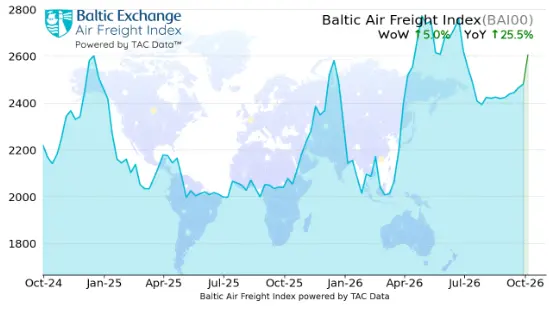
Baltic Air Freight Index chart showing global air cargo rate trends from October 2024 to October 2026, including weekly and yearly freight rate changes.

Demand: Global air cargo demand rose 3.9% year-on-year in July, with international traffic up 4.7%. 

Capacity: Global air cargo capacity increased 1.7%, trailing demand and lifting load factors to 46.0%. 

News: Dedicated freighter traffic surged 13.9%, while belly-hold cargo fell 7.0% amid passenger disruptions. 

The Middle East and Air Carriers

Recent update shows continued strength on Europe-to-UAE air freight lanes, with rates rising week over week. TAC Index also highlighted newly added Greater Bay Area-to-Dubai lanes, reflecting Dubai’s importance in regional air cargo flows.

Asia

Air freight rates generally strengthened across major Asian markets. Hong Kong outbound rates rose 3.0% week over week and 22.3% year over year, while Shanghai increased 2.2% week over week and 18.3% year over year. Japan and Seoul also recorded gains, while Taiwan, Bangkok and some India spot rates softened. 

America

North American air freight rates were mostly stronger, particularly on routes to Europe, the UK, China and Korea. Chicago outbound rates climbed 9.2% week over week and 77.2% year over year. Mexico-to-Europe rates also increased strongly, while some lanes to South America declined. Brazil and Mexico also saw higher inbound rates from Europe. 

Europe

European outbound rates strengthened overall, led by sharp increases on Transatlantic routes to the US and gains to China, Japan, Brazil, Mexico, the UAE, Australia and South Africa. Frankfurt rose 2.0% week over week and 46.0% year over year, while London Heathrow jumped 28.2% week over week. 

October 2026 Shipping Insights for the UAE

Maersk introduced a new Storage Import charge at Khor Fakkan for carrier-haul imports, covering storage and reefer plug-in costs. Read More 

CMA CGM warned of rising Colombo Port congestion, likely causing longer waiting times, berthing delays, and shipment schedule disruptions. Read More 

Recurring East Asia typhoons are increasing port congestion and reducing vessel reliability, prompting Maersk to recommend added shipment buffers and alternatives. Read More 

MPCI filing becomes mandatory from 1 October 2026, with operators required to maintain registration, system readiness, and uninterrupted compliance. Read More 

Maersk introduced a PSS from North Europe and the Mediterranean to Somalia and Tanzania, effective 7 October 2026. Read More 

Maersk introduced a PSS from North Europe and the Mediterranean to Kenya, effective 7 October 2026. Read More 

Maersk announced new Far East to North Europe and Mediterranean freight rates, effective from 19 October 2026. Read More 

Ajman-bound cargo discharged at Khorfakkan must move via Sajaa ICD, adding USD 1,100 dry and USD 1,350 reefer charges. Read More 

Dubai will enforce new truck movement restrictions from 1 October 2026, requiring transporters to adjust routes and delivery schedules. Read More 

CMA CGM requires UAE customers to verify VAT and legal entity details through its portal to support MPCI compliance. Read More 

Maersk will reroute AE12 through the Suez Canal in both directions, starting with Umm Qarn on 27 October 2026. Read More 

Global Factory Output – Overview

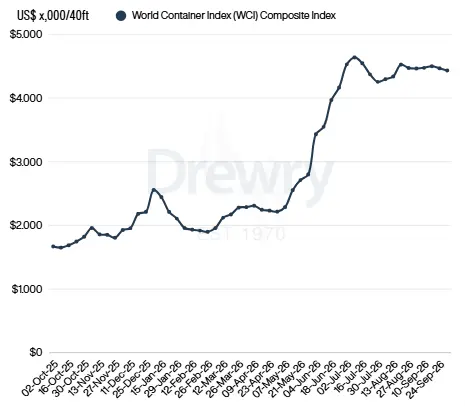
Drewry World Container Index chart showing global ocean freight rate trends per 40ft container from October 2025 to September 2026.

The Drewry World Container Index fell 1% to $4,434 per 40ft container, mainly due to lower Asia-Europe rates. 

United States of America (USA)

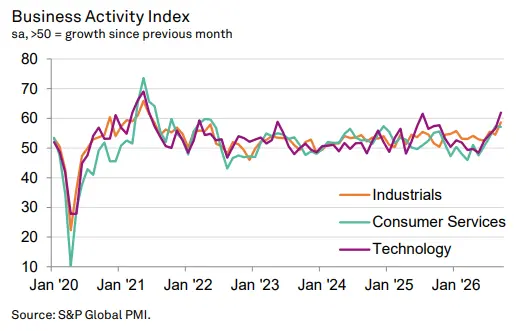
US Business Activity PMI chart comparing industrial, consumer services, and technology sector performance through September 2026.

All seven US sectors expanded in September, with most gaining momentum. Technology led growth at its fastest pace since 2021, while Industrials reached a five-year high. Basic Materials and Consumer Goods strengthened, while Healthcare remained the weakest sector. 

United Kingdom (UK)

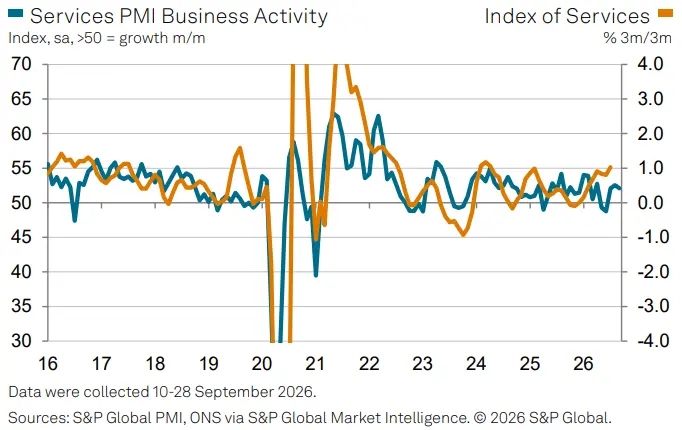
UK Services PMI Business Activity chart showing monthly services sector growth and the Index of Services trends through September 2026.

UK services growth slowed in September as weaker demand, geopolitical tensions, high borrowing costs, and inflation weighed on activity. Technology remained resilient, job losses eased, while rising fuel costs pushed input expenses and selling prices higher. 

China

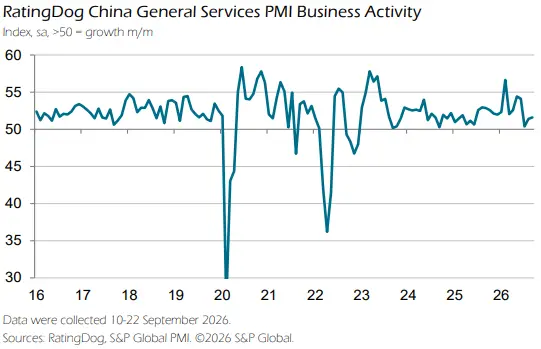
RatingDog China General Services PMI chart showing monthly services sector business activity and economic growth trends through September 2026.

China’s services PMI rose to 51.6 in September, marking faster but modest growth. New business and exports strengthened, employment increased, and confidence improved. However, input costs continued rising while intense competition pushed selling prices sharply lower, putting pressure on company profit margins. 

United Arab Emirates (UAE)

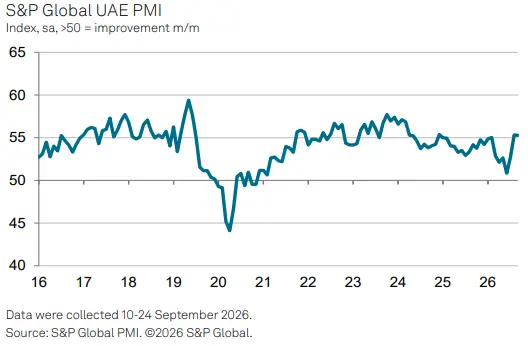
S&P Global UAE PMI chart showing business activity trends and non-oil private sector economic performance through September 2026.

The UAE PMI remained strong at 55.3 in September as domestic and export demand improved. However, higher input costs and selling prices persisted, while cautious business expectations kept hiring modest despite stronger order growth and renewed employment. 

Section Title

Supply Chain and Logistics Update – November 2026

UAE Trade Maintains Double-Digit Growth Despite Global Economic Pressures The UAE recorded double-digit foreign trade growth during the first nine months of 2026, demonstrating economic resilience...

Supply Chain and Logistics Update – October 2026
UAE Pushes for Deeper Gulf Industrial Integration The UAE is seeking closer industrial co-operation with GCC countries to strengthen regional supply chains, support economic diversification, and...

Logistics and Supply Chain Update – September 2026

UAE Accelerates Alternative Trade and Energy Corridors The UAE is expanding alternative routes for energy exports and international trade as the conflict with Iran continues to disrupt regional...

August 2026 | Supply Chain & Logistics Update

Ocean Freight Capacity Tightens Across Trade Lanes as Peak Season Supports Elevated Rates Ocean freight capacity is tightening across several secondary trade lanes as peak-season demand, carrier...

Logistics & Supply Chain Market Update – July 2026

Fuel Market Update: Crude Prices Ease, but Fuel Costs Remain Elevated Crude Prices Decline as Risks Ease Brent crude fell below pre-conflict levels, reaching USD 72.49 per barrel on 3 July 2026, down...

IOR & EOR – Importer on Record / Exporter on Record

Understanding the role of IOR and EOR services in UAE and GCCis essential for businesses moving goods across borders. Importer of Record (IOR) and Exporter of Record (EOR) services ensure that...

Supply Chain & Logistics Update – June 2026

India‑Oman CEPA Enters into Force The India‑Oman Comprehensive Economic Partnership Agreement (CEPA) officially entered into force on June 1, 2026, marking a fresh chapter in bilateral economic ties...

ECommerce Return Management Services- Complete Guide

The rise of online shopping has significantly increased e-commerce returns in the UAE, directly impacting profitability, operational costs, and customer satisfaction. Globally, return rates for online...

FMCG Freight Management Services in UAE

The fast-paced nature of FMCG products, with short shelf lives, high turnover, and extensive distribution networks, makes efficient freight management services in the UAE crucial for business success...

Tags: Update

Related Articles

Post a comment